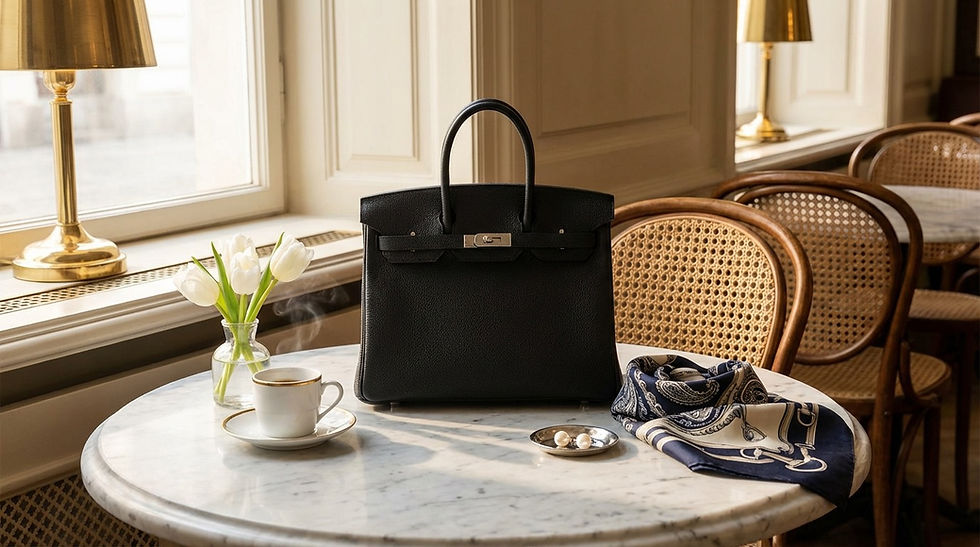
Few luxury products embody exclusivity like the Hermès Birkin bag. A cultural icon coveted worldwide, the Birkin is known for its esteem, craftsmanship, and limited availability.[1] Hermès tightly controls the bag’s distribution, using scarcity tactics to reinforce its prestige and resale value.[2] That strategy, however, has recently sparked legal controversy.[3]
The 2024 Cavalleri v. Hermès International class action lawsuit centers on what plaintiffs describe as Hermès’ relationship-based retail system.[4] Unlike a typical retail product, plaintiffs allege that the Birkin is available only by offer from Hermès, with the brand considering a customer’s purchase history and relationship with sales associates when deciding whether to extend an invitation.[5]
Plaintiffs contend that this system disguises the true cost of obtaining a Birkin.[6] Although the bag carries a listed retail price, the real cost includes thousands of dollars that consumers are effectively forced to spend on ancillary Hermès products in hopes of improving their chances of an offer to purchase.[7] According to the plaintiffs’ theory, the sales model generates revenue from customers who may never “qualify” for a Birkin and leaves them with products they would not have otherwise purchased.[8]
Plaintiffs framed this practice as an “unlawful tying arrangement” under the Sherman Antitrust Act, a U.S. law that makes it illegal for companies to restrain trade, fix prices, or use their market power to unfairly limit competition.[9] Under the Sherman Antitrust Act, an unlawful tying arrangement occurs when a seller conditions the sale of one product (the “tying product”) on the buyer’s purchase of a separate product (the “tied product”).[10] Courts can evaluate tying claims through the “rule of reason” three-element standard: two distinct products, market power in the tying product market, and a “not-insubstantial” amount of commerce affected in the tied product market.[11] In this case, the alleged tying product is the Birkin handbag itself, while tied products include Hermès scarves, clothing, jewelry, accessories, and home goods.[12]
The district court dismissed the complaint after finding several pleading deficiencies.[13] First, the court rejected the plaintiffs’ proposed market for the Birkin: “elitist luxury handbags in the United States.”[14] The court was unpersuaded by the plaintiffs’ reliance on outdated articles and general consumer perceptions, instead requiring more substantial economic analysis to support the existence of an “elitist luxury handbags” market and its connection to the Birkin bag.[15]
Second, the court concluded that, without a properly defined market, it is impossible to evaluate whether Hermès holds market power.[16] The court further emphasized that, regardless of whether the relevant market is properly defined, plaintiffs’ assertion that Hermès dominates the “elitist luxury handbags” market alone does not establish the market power necessary for a “predatory” tying claim.[17]
Finally, the court held that the complaint failed to plausibly allege harm to competition.[18] Even if consumers were effectively “forced” to purchase additional products, the court emphasized a core principle of antitrust law: the law protects competition, not individual consumers.[19] Because other luxury brands remain free to compete in the various markets for scarves, clothing, and accessories, the complaint did not sufficiently show that Hermès’ practices restricted competition.[20]
After dismissal of plaintiffs’ second amended complaint in September 2025, plaintiffs’ appealed to the Ninth Circuit, which is ongoing now in 2026.[21] The appeal focuses on several issues, including whether the proposed “elitist luxury handbag” market should survive a motion to dismiss and whether the Birkin’s prestige and resale value could support a finding of single-brand market power.[22] Plaintiffs also contend that the district court improperly analyzed the complaint under a “rule-of-reason” standard rather than a traditional “per se” tying standard.[23] They further argue that the alleged system does actually distort competition by steering consumers toward Hermès accessories rather than competing luxury brands such as Chanel or Louis Vuitton.[24]
The case raises broader questions about how antitrust law should treat luxury markets built on exclusivity and scarcity. Exclusivity and scarcity have long been defining features of luxury branding, helping sustain high prices and reinforce prestige. Yet, this Hermès litigation asks whether such strategies become anticompetitive when access to a highly desired product is conditioned on purchasing others. The Ninth Circuit’s decision may therefore help determine whether luxury brand gatekeeping is simply an effective marketing strategy or unlawful tying under antitrust law.
________________________________________________________________________________________________
the-hermes-birkin?utm (noting that Sotheby’s has sold nearly $100 million in Birkin bags since 2021, reflecting bag’s exceptional global demand and enduring reputation).
[3] See Cavalleri v. Hermès Int’l, No. 24-cv-01707-JD, 2025 WL 2662897 (N.D.Cal. Sep. 17, 2025).
[5] See id. (explaining plaintiffs’ allegation that Hermès will only sell Birkin bags to those “deemed worthy”). According to the complaint, worthiness is measured by past loyalty, including purchases of Hermès shoes, scarves, jewelry, or clothing. See id.; see also Bari Brandes Corbin, Mastering the Art of Hermès Pre-Spend and Building Relationships, Purse Blog (May 31, 2023), https://www.purseblog.com/hermes/hermes-pre-spend/ (describing Hermès’ relationship-based retail process). The author explains that the Hermès purchasing process encourages customers to cultivate relationships with sales associates, make cross-department purchases, and buy consistently, implying that loyalty and engagement can earn access to coveted items. See id.
[7] See id. (articulating plaintiffs’ argument that the Birkin’s retail price is actually one of many purchases customers are “effectively forced” to purchase); see also Corbin, supra note 5 (utilizing colloquial term “Birkin Bait” to describe items customers purchase across Hermès departments to increase likelihood of offer to purchase Birkin bag).
[9] See Cavalleri, 2025 WL 2662897, at *1; see generally Sherman Act, 15 U.S.C. §§ 1, 2.
[10] See Rick-Mik Enter., Inc. v. Equilon Enter., Inc., 532 F.3d 963, 971 (9th Cir. 2008) (defining tying arrangement as “device used by a seller with market power in one product market to extend its market power to a distinct product market”). The court explained that tying arrangements are prohibited because a seller with market power over the tying product can leverage that power to exclude competing sellers of the tied product. See id.; see generally 15 U.S.C. §§ 1, 2.
[11] See Cavalleri, 2025 WL 2662897, at *2; see generally Sterling Miller, Antitrust Law Basics – Section 1 of the Sherman Act, Thomson Reuters (May 2, 2023), https://legal.thomsonreuters.com/blog/antitrust-law-basics-section-1-of-the-sherman-act/ (discussing two main standards courts use to determine whether business arrangements unreasonably restrain trade). Under the “per se” rule, certain tying arrangements are considered inherently anticompetitive and unlawful without further analysis. See id. Under the “rule of reason,” courts analyze non-per se arrangements using three elements to determine if the “commercial benefits outweigh any competitive harm.” Id.
[12] See Cavalleri, 2025 WL 2662897, at *2.
[13] See id. (concluding that the plaintiffs failed to adequately plead all three elements required for an unlawful tying claim).
[14] See id. (finding that plaintiffs failed to allege facts that would make element one’s claims anything more than conclusory).
[15] See id. (criticizing the plaintiffs’ reliance on just two academic articles that merely described consumer perceptions of product quality and exclusivity from more than a decade earlier). The court explained that this was a “far cry” from properly defining a relevant market for antitrust purposes. See id.
[16] See id.; see also Ohio v. Am. Express Co., 585 U.S. 529, 542-43 (2018) (stating that market power requires the definition of a proper product market).
[17] See Cavalleri, 2025 WL 2662897, at *2 (finding that “market share or position are not the same as market power”); see also Rebel Oil Co., Inc. v. Atlantic Richfield Co., 51 F.3d 1421, 1439 (9th Cir. 1995) (stating that “mere showing of substantial or even dominant market share alone cannot establish market power sufficient to carry out a predatory scheme”).
[18] See Cavalleri, 2025 WL 2662897, at *3.
[19] See id. (finding that regardless of whether Hermès reserves Birkin bags for its highest-paying customers, such conduct alone does not constitute an antitrust violation); see also Brantley v. NBC Universal Inc., 675 F.3d 1192, 1202 (9th Cir. 2012) (stating that “[b]usinesses may choose the manner in which they do business absent an injury to competition”).
[20] See Cavalleri, 2025 WL 2662897, at *3 (articulating that plaintiffs’ complaint lacks facts supporting the “lumping” of such diverse ranges of non-substitutable products into single market and similarly lacks allegations that Hermès unlawfully restrained competition for those goods). The court reached this conclusion considering the breadth of the alleged “tied market,” which it described as a “kaleidoscope” of products, including “scarves and shawls, ready-to-wear clothing, footwear, watches, jewelry, fragrances, accessories (including hats, gloves, ties, and sunglasses),” and home goods. Id.
[21] See Inside the Case, supra note 6.
[22] See id. (summarizing plaintiffs’ claim that Ninth Circuit precedent does not require them to plead market definition with precision at the motion-to-dismiss stage).
[23] See id. (noting that at a hearing before the second amended complaint was filed, Judge Donato “expressed skepticism” about per se tying claims); see generally Miller, supra note 11 (explaining difference between per se and rule of reason tying standards).
[24] See id. (explaining that plaintiffs’ appeal points to resale data suggesting higher percentage of non-handbag Hermès goods appear on secondary markets in pristine condition compared to competitors). Plaintiffs argue this supports an inference of coerced purchasing. See id.



Comments